Table of Contents
- Why Line Material Matters More Than the Brand on the Box
- Monofilament: Nylon, Extrusion, and Why It Still Dominates
- Fluorocarbon: The PVDF Advantage
- Braided Line: UHMWPE Fibers and Why Strand Count Matters
- Copolymer Lines: The Hybrid Most Anglers Skip
- The Material Comparison Table
- The Counterintuitive Truth About "Premium" Fluoro
- How Manufacturing Quality Affects What You Feel on the Water
- FAQ
A bass takes a Texas-rigged worm worked through a grass bed. Not a nibble , a freight train of a strike.
The rod doubles over, drag screaming. Fifteen seconds later the line goes slack, and what comes back is a frayed, curly end of 12lb monofilament that simply gave up.
The same line had been on the reel for three weeks without a check.
The question most anglers never ask: what is this stuff actually made of? Most buyers grab whatever is on sale at the tackle shop.
Berkley Trilene one trip, Stren the next, without ever looking at the material. That gap is what this guide closes.
Fishing line comes down to four families of materials: nylon (monofilament), PVDF (fluorocarbon), UHMWPE (braid), and nylon-copolymer blends. Each one behaves completely differently underwater.
Once you understand the chemistry behind each, you stop guessing , and you stop losing fish to the wrong line in the wrong place.
Why Line Material Matters More Than the Brand on the Box
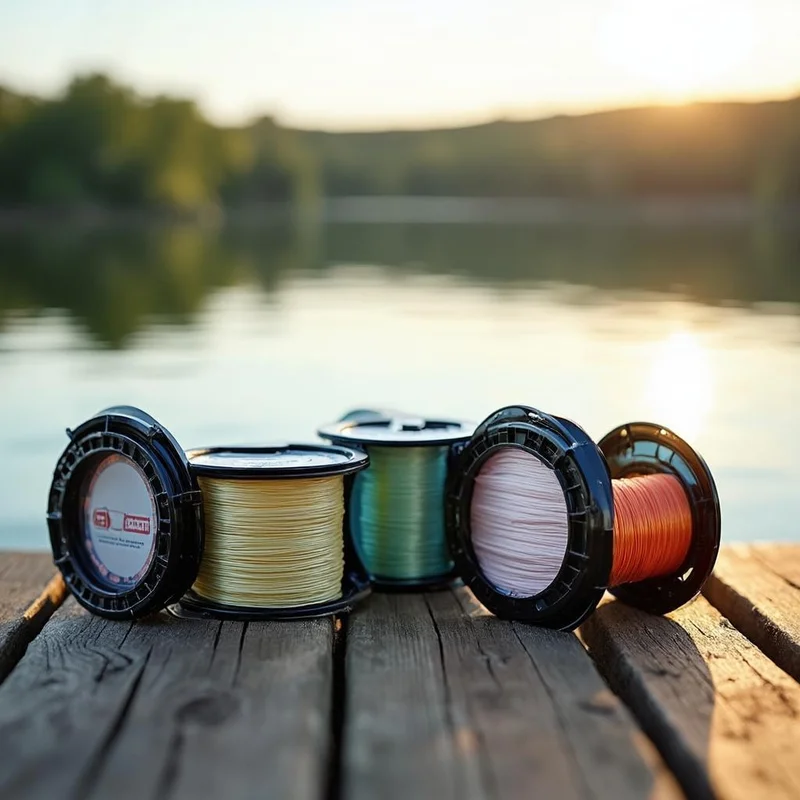
A cheap digital microscope , the kind that plugs into a phone and magnifies 200x , makes the difference visible.
Four spools cover the main families: Berkley Trilene XL ($6 for 330 yards), Seaguar InvizX ($25 for 200 yards), PowerPro Spectra ($18 for 150 yards), and a no-name copolymer from a gas station.
Under magnification they are completely different materials. Cheap mono shows a rough, inconsistent surface with tiny pits and grooves. Fluorocarbon such as Seaguar is glass-smooth and uniform.
Braid shows individual micro-fibers woven into a tight helix.
A gas-station copolymer sits somewhere between mono and fluoro , smoother than the cheap stuff but with a visible seam where the two nylon variants were fused during extrusion.
These are not interchangeable commodities. They are engineered polymers with vastly different molecular structures, and those differences show up in every cast, every hookset, every fight.
Monofilament: Nylon, Extrusion, and Why It Still Dominates
Standard monofilament is nylon , specifically nylon 6 or nylon 6,6. These are the same polymers used in everything from toothbrush bristles to car engine covers.
The fishing version is extruded through precision dies at temperatures around 480°F, then stretched in a controlled cooling bath that aligns the polymer chains for strength.
The brilliance of nylon monofilament is that it's a single strand. No weaving. No bonding. Just one continuous extruded fiber. That's why it stretches 15-25% before breaking , the polymer chains literally elongate under load.
That stretch is both mono's superpower and its weakness.
Mono absorbs water. Over 24 hours submerged, a typical nylon line absorbs about 2-4% of its weight in water. This actually softens the line slightly and makes it more supple.
It also means mono sinks slowly , slower than fluoro, much slower than braid. That floating characteristic is why topwater anglers have loved mono for 80 years.
UV light is mono's enemy. Nylon polymer chains degrade under ultraviolet radiation. A spool left on the deck of a boat for a full summer can lose 30-40% of its breaking strength.
Two-year-old 8lb mono that has lived in a garage window can break at less than half its rating.
Replace your mono every season, even if it looks fine.
Berkley Trilene XL , 8lb, 330 yards, ~$6
The nylon mono to reach for in general-purpose fishing. It's not the strongest. It's not the most abrasion-resistant.
But at $0.018 per yard, it's the line for rods that see rocks, docks, and beginners. The low memory means fewer wind knots on spinning gear.
Spool a loaner rod with this and forget about it.
Check Price on AmazonFluorocarbon: The PVDF Advantage
Fluorocarbon line is made from polyvinylidene fluoride , PVDF for short. It's a fluoropolymer, meaning fluorine atoms are bonded to the carbon backbone of the polymer chain. Those fluorine atoms are what make fluoro nearly invisible underwater.
Here's the physics: light bends when it passes between materials of different densities. The refractive index of water is 1.33.
Nylon mono has a refractive index around 1.53 , a big jump, which is why mono is visible underwater. PVDF has a refractive index of 1.42.
That's extremely close to water, making fluorocarbon almost disappear below the surface. This isn't marketing hype. It's optics.
PVDF is also denser than nylon , about 1.78 g/cm³ vs 1.15 g/cm³. That's why fluoro sinks.
A 4lb fluorocarbon leader will drop through the water column about twice as fast as the same diameter in mono. For bottom-contact baits like jigs and drop shots, that density is an advantage.
For topwater, it's a disaster , the line pulls your floating lure under.
Fluorocarbon doesn't absorb water. Unlike nylon, PVDF is hydrophobic. It stays the same strength wet or dry. It also doesn't degrade from UV exposure nearly as fast as mono.
Keep 6lb fluorocarbon dry and out of direct sun and it still breaks close to its rating two seasons later.
The tradeoff: fluoro is stiff. That PVDF backbone makes the line less supple than nylon. On spinning reels under 2500 size, heavy fluoro (over 10lb) will spring off the spool and create nightmares.
15lb InvizX on a size 1000 reel. Don't do it.
Seaguar InvizX , 6lb, 200 yards, ~$25
The workhorse fluorocarbon for clear-water situations. The 6lb holds closer to 8lb with a Palomar knot. At $0.125 per yard, it's not cheap.
For pressured bass on clear reservoirs, this is the line to trust when every bite matters.
Check Price on AmazonBraided Line: UHMWPE Fibers and Why Strand Count Matters
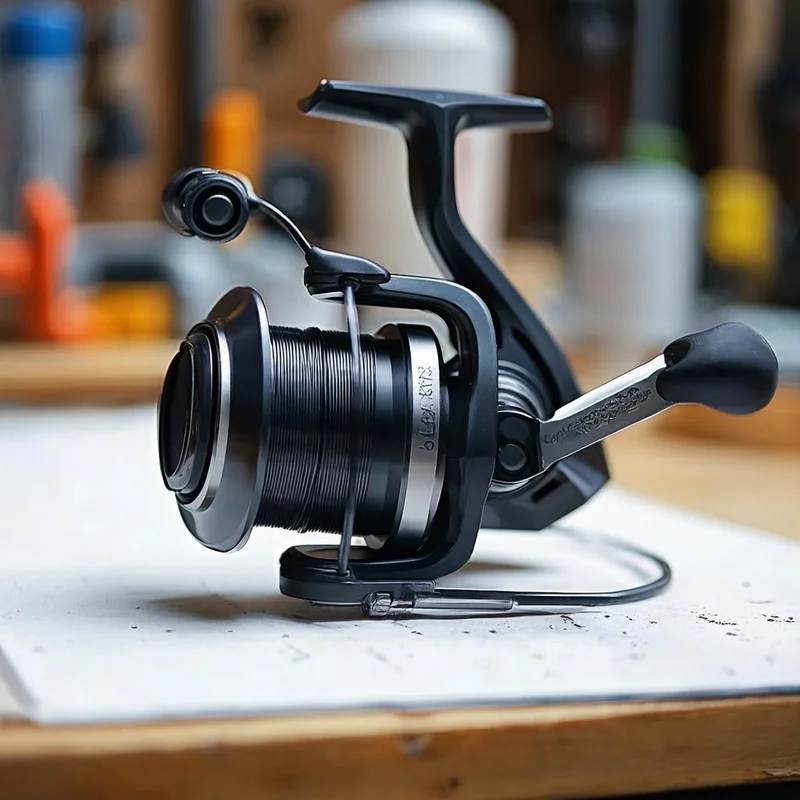
Braided fishing line is made from Ultra-High Molecular Weight Polyethylene , UHMWPE. This is the same material used in bulletproof vests and prosthetic joints. It's unbelievably strong for its diameter.
A single strand of UHMWPE fiber thinner than a human hair can hold over 2 pounds.
Manufacturers spin these fibers into bundles called "carriers," then weave the carriers together. A 4-carrier braid means four bundles woven together. An 8-carrier braid uses eight bundles, creating a rounder, smoother profile.
The strand count printed on the box , 4-strand, 8-strand, 12-strand , refers directly to how many carriers were used.
More carriers = rounder line = quieter through guides = better casting distance. But also higher cost.
A 4-carrier braid like original PowerPro ($18 for 150 yards) is slightly flat and noisy through guides , you can hear it.
An 8-carrier braid like Sufix 832 ($25 for 150 yards) is nearly silent and casts noticeably farther. The difference on a baitcaster with 30lb braid is about 8-10 extra feet of casting distance.
Braid has zero stretch. None. That's the defining characteristic. Every tap, every tick of a fish's mouth, transmits instantly to your hand.
It's why braid dominates in deep water, heavy cover, and any situation where sensitivity matters.
It's also why braid rips hooks out of mouths if you swing too hard , there's no give to absorb the shock.
UHMWPE floats. Braid sits on the surface film, making it the king of frog fishing and topwater. But it's highly visible. Fish can absolutely see it in clear water.
Always use a fluorocarbon or mono leader with braid, regardless of what color your braid is.
Green, moss, white, and hi-vis yellow behave the same way here: trout will spook from any of them in 6-foot visibility without a leader.
Copolymer Lines: The Hybrid Most Anglers Skip
Copolymer lines blend two different nylon polymers during extrusion. The goal is to get the best of both worlds: less stretch than mono, less stiffness than fluoro, and a lower price than either premium option.
The most common formulation pairs a stiff nylon variant with a more elastic one. The stiff component reduces overall stretch , typically to 8-12%, compared to mono's 15-25%.
The elastic component maintains knot strength and shock absorption. The two polymers are literally melted together in the extrusion barrel before being forced through the die.
P-Line CXX is a well-known copolymer. the 8lb version works for crankbaits. It stretches about 10%, which is enough give to keep treble hooks pinned but not so much that you lose feel.
At $10 for 300 yards, it splits the cost difference between cheap mono and premium fluoro.
The downside: copolymer isn't as abrasion-resistant as pure fluorocarbon, and it's more visible than fluoro. It's a compromise line for compromise situations , dirty water, reaction baits, times when you don't need perfection.
The Material Comparison Table
| Property | Nylon Mono | PVDF Fluoro | UHMWPE Braid | Copolymer |
|---|---|---|---|---|
| Base Material | Nylon 6 or 6,6 | Polyvinylidene fluoride | Ultra-high molecular weight PE | Nylon blend |
| Stretch | 15-25% | 5-10% | 0% | 8-12% |
| Density | 1.15 g/cm³ (floats) | 1.78 g/cm³ (sinks) | 0.97 g/cm³ (floats) | 1.12-1.18 g/cm³ |
| Refractive Index | 1.53 (visible) | 1.42 (nearly invisible) | Opaque (highly visible) | ~1.52 |
| UV Resistance | Poor | Excellent | Good | Moderate |
| Water Absorption | 2-4% | 0% | 0% | 1-3% |
| Diameter at 10lb | ~0.30mm | ~0.28mm | ~0.20mm | ~0.29mm |
| Cost per 100yd | $2-5 | $8-15 | $8-18 | $3-8 |
The Counterintuitive Truth About "Premium" Fluoro
The most expensive fluorocarbon on the shelf is rarely the right one for your reel size.
Premium fluoro lines use higher-grade PVDF resin with fewer impurities. The extrusion process is tighter. The diameter is more consistent.
All of this is true, and it matters , but only if your reel can handle it.
On a size 2500 or 3000 spinning reel, premium 100% fluorocarbon like Seaguar Tatsu ($40 for 200 yards) is a joy. It lays flat, casts beautifully, and disappears underwater.
Put that same Tatsu on a size 1000 ultralight reel and you'll hate it. The line is too stiff for the small spool diameter. It springs off in coils.
You'll spend half your morning picking out wind knots.
A $40 premium fluoro on a small-spool reel buys less than a $12 nylon-based line such as Trout Magnet SOS, which lies flat and casts cleanly.
The lesson: match the material to your gear, not to the price tag. For reels under size 2000, nylon mono or a soft copolymer will outperform stiff fluoro every time regardless of what you paid.
Save the premium fluoro for baitcasters and larger spinning reels where the stiffness becomes an asset , better sensitivity, better hook-setting authority.
This ties directly into how you set up leaders. For more on getting that blend right, read our guide on fluorocarbon leader length for bass , the same principles of diameter and stiffness apply.
How Manufacturing Quality Affects What You Feel on the Water
Not all nylon is created equal. The quality of the raw polymer pellets, the precision of the extrusion die, and the consistency of the cooling bath all affect the final line.
Cheap mono often uses recycled nylon with inconsistent molecular weight. That's why it breaks unpredictably , some sections of the line are weaker than others because the polymer chains aren't uniform.
A cheap micrometer and a digital scale make the difference measurable. A $3 spool of generic 6lb mono varies far more across a spool than a branded line does.
Breaking strength drifts the same way, so breakoffs from a cheap spool look random. Tight extrusion control keeps a branded line closer to a single figure from end to end.
Twice the consistency for twice the price.
With braid, the difference shows up in the weaving. Cheap 4-carrier braids often have loose spots where the carriers weren't pulled tight during manufacturing.
These loose sections create weak points and make the line noisy through guides. Quality braids like Sufix 832 use a tighter weave and often add a Gore fiber for roundness and reduced friction.
For a deeper dive into how line diameter affects everything from casting to sensitivity, see our fishing line diameter chart , matching actual diameters, not just labeled pound tests, is the fastest way to fix spooling problems.
FAQ
Is fluorocarbon really invisible underwater?
Nearly. Its refractive index of 1.42 is very close to water's 1.33. Mono is 1.53 , a much bigger gap.
In clear water with 8+ feet of visibility, the difference is real: fish will inspect a bait on mono from farther away and often refuse it.
In stained water with less than 2 feet of visibility, the advantage shrinks dramatically. For murky ponds and rivers, save your money and fish mono.
Why does braided line have a strand count, and does it matter?
Strand count tells you how many fiber bundles were woven together. 4-strand braid is flatter, noisier through guides, and cheaper. 8-strand is rounder, quieter, and casts farther. 12-strand is the smoothest but most expensive.
For most freshwater fishing, 8-strand is the sweet spot , noticeably better than 4-strand without the $35+ price tag of 12-strand. For heavy cover flipping where casting distance doesn't matter, 4-strand is all you need.
Can I leave fluorocarbon on my reel all winter?
Yes , unlike mono, fluoro doesn't absorb water and doesn't degrade significantly from sitting.
The caveat: check for kinks and abrasion before fishing it. Fluoro develops permanent weak spots where it's been sharply bent or nicked against rocks.
If you feel any roughness running it between your fingernails, cut back 10 feet or respool.
Why does copolymer exist? Isn't it just cheap fluoro?
Copolymer isn't trying to be fluoro. It's improved mono. By blending two nylon types, manufacturers create a line that stretches less than pure mono (better sensitivity) while staying softer and cheaper than fluoro.
It fills the gap for anglers who want better feel than mono but can't stomach $25 for a 200-yard spool of fluorocarbon.
For crankbaits, spinnerbaits, and reaction lures, copolymer is genuinely the better choice , the slight stretch keeps treble hooks pinned.
Sources & Industry References
- International Game Fish Association (IGFA) , Official world record authority and fishing line standards reference
- Wired2Fish , Independent fishing gear reviews and line testing data
- Tackle Warehouse , Comprehensive fishing line specs, diameter charts, and user reviews
Found This Guide Helpful?
Check out LineCalc Pro , our free fishing line calculator that recommends the perfect line for your exact setup. No guessing, no wasted money.
Try LineCalc Pro →