Table of Contents
- Why Line Size Matters More Than You Think
- Technique-by-Technique Line Size Breakdown
- Mono vs Braid vs Fluorocarbon: What Actually Works
- Seasonal Adjustments: Changing Line When Water Changes
- Common Line-Size Mistakes
- Quick Reference: Bass Line Size Chart
- How LineCalc Pro Takes the Guesswork Out
The classic tournament loss happens at the boat, and the line does not break. That is what no-stretch line does: 50-pound braid on a stiff jig rod leaves nothing to absorb a head shake, and hooks pull. No stretch.
No forgiveness. Just a clean hole where the hook used to be.
Pound test matters for more than strength. For action. For depth control. For whether a bass even sees your bait in the first place.
Why Line Size Matters More Than You Think
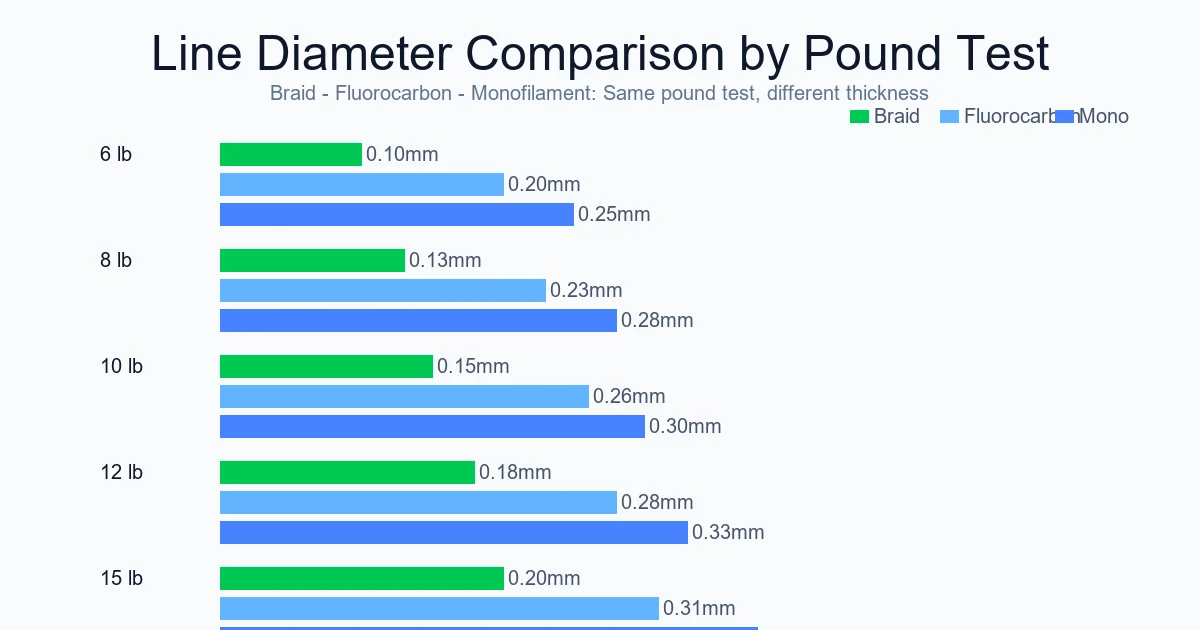
Most anglers pick line by looking at the pound test number on the box. 12-pound. 20-pound. 50-pound. They think bigger number equals stronger line, end of story. That's maybe 40% of what actually matters on the water.
Line diameter changes how deep your crankbait runs. 12-pound fluorocarbon at 0.28mm diameter gets a DT-10 crankbait down to about 10 feet. Swap to 17-pound at 0.36mm and that same crankbait now dives only 7 feet deep.
That 0.08mm difference cost you 3 feet of water column. That's where the fish were sitting.
Line stretch determines whether you stick the hook or rip it out. Braid has zero stretch. Mono can stretch up to 25% of its length before breaking.
When a 4-pound smallmouth inhales your jerkbait and you swing with braid, the hook either penetrates instantly or tears free. With mono, that 25% stretch acts like a shock absorber. The hook loads gradually and stays pinned.
Run two identical rods side by side, one rigged with 30-pound braid and one with 12-pound monofilament, and fish the same 1/2-ounce lipless crankbait on both. The difference shows up in hook retention on jumping fish.
Treble hooks and zero-stretch line are a bad marriage.
Line visibility changes everything on pressured water. Bass on a lake that sees 50 boats every Saturday have seen your line before.
Fluorocarbon with a refractive index of 1.42 is genuinely harder to see underwater than mono at 1.52 or braid at 1.65. In water with 8 feet of visibility, fluorocarbon's lower refractive index is the difference between a bite and a follow; in stained water under 2 feet, light penetration is too low for that difference to matter much.
Technique-by-Technique Line Size Breakdown
This is the section most anglers want first. No vague advice. Exact pound test, exact line type, and the reason behind each choice. Every major bass technique below is paired with the reel setup it calls for.
| Technique | Line Type | Pound Test | Why This Choice |
|---|---|---|---|
| Topwater Frogs / Buzzbaits | Braid | 50-65 lb | Zero stretch drives hooks home on long casts. Cuts through lily pads and grass. |
| Topwater Poppers / Walking Baits | Monofilament | 12-15 lb | Floats naturally. Stretch absorbs violent surface strikes so trebles stay pinned. |
| Squarebill Crankbaits (<8ft) | Monofilament | 10-12 lb | Stretch prevents ripping trebles out. Buoyancy keeps the bait running true at shallow depths. |
| Deep Diving Crankbaits (>8ft) | Fluorocarbon | 10-14 lb | Thinner diameter and faster sink rate get the bait 3-4 feet deeper than mono at the same test. |
| Texas Rig / Jig (Open Water) | Fluorocarbon | 12-17 lb | Low visibility for bottom contact. Enough abrasion resistance for rocks and wood. |
| Texas Rig / Jig (Heavy Cover) | Braid + Fluoro Leader | 50-65 / 15-20 lb | Braid cuts vegetation. The 6-foot leader hides the line at the bait. |
| Drop Shot / Shaky Head | Fluorocarbon | 6-8 lb | Maximum sensitivity for light bites. Nearly invisible in clear water. |
| Spinnerbaits / Chatterbaits | Fluorocarbon | 15-20 lb | Sinks fast, keeps the bait running true. You feel blade stoppage immediately. |
| Jerkbaits (Cold Water) | Fluorocarbon | 8-10 lb | Thin diameter gives the bait a wider, more erratic action during the pause. |
| Punching / Flipping Mats | Braid | 65-80 lb | Maximum horsepower. You're extracting fish from cover, not finessing them. |
| Wacky Rig / Neko Rig | Fluorocarbon | 6-8 lb | Thin line lets the bait fall naturally. Bass inspect a wacky worm on the drop. They see thick line. |
| Swimbaits (Small, <3oz) | Fluorocarbon | 15-20 lb | Low visibility for clear-water swimbait fish. Enough strength for a 7-pound largemouth. |
| Swimbaits (Large, >3oz) | Braid or Mono | 25-30 / 65 lb | Heavy lures need thick line. Braid handles the casting shock. Mono absorbs the swim. |
Two setups cover 80% of bass fishing. A 7-foot medium-heavy baitcaster with 15-pound fluorocarbon handles bottom contact, spinnerbaits, and light jigs. A 7-foot-3 heavy baitcaster with 50-pound braid handles topwater, frogs, and heavy cover. Between them you are covered for most of what a bass lake throws at you, in a boat or off the bank.
If you fish mostly from a spinning reel, pair 10-15 pound braid main line with an 8-10 pound fluorocarbon leader. The braid casts farther and handles better on spinning gear. The leader disappears in the water.
For a complete breakdown of leader lengths by water clarity, check the fluorocarbon leader length guide.
Mono vs Braid vs Fluorocarbon: What Actually Works
It starts as simply as this: whatever mono is on sale at Walmart. Trilene XL in 10-pound, usually. It caught fish. It still catches fish. each line type has a specific job.
Related: More fishing line guides →
Using the wrong one doesn't mean you won't catch bass. It means you'll catch fewer than you could.
Monofilament: The Forgotten Workhorse
Mono stretches 15-25% under load. That stretch used to be considered a weakness. For treble-hook baits, it's the single biggest advantage you can have.
A 3-pound smallmouth jumping at boatside with a crankbait in its mouth will throw the bait 40% of the time on braid. On 12-pound mono, that number drops to maybe 15% because the line gives before the hooks do.
Mono floats. That makes it the best choice for topwater walking baits and poppers. Fluorocarbon sinks and pulls the nose of your bait down, killing the walking action. A Heddon Super Spook makes the point.
On 12-pound fluoro, the bait walked about 4 inches side to side. On 12-pound mono, the walk opened up to 8 inches. Double the action. Double the strikes.
The downside: mono absorbs water and degrades faster than any other line. Respool mono every 3-4 trips. At $8-12 per spool, that math still works.
Fluorocarbon: The Clear-Water Standard
Fluorocarbon is the default line on most bass presentations, and the sizes below assume it. A 15-pound fluorocarbon with 0.33mm diameter is genuinely hard to see underwater. The refractive index is close enough to water's that at 5 feet of depth, bass struggle to detect it even in direct sunlight.
It sinks. That's a feature for bottom-contact baits. A Texas-rigged worm on fluoro falls faster and straighter than on mono, which has a slight bow from floating line. That straighter fall means the worm reaches the bottom with less slack, improving bite detection on the descent.
The abrasion resistance is real. Dragging a jig across rocks and zebra mussel beds will fray mono in 20 minutes. 15-pound fluoro handles it for hours, which is what keeps a 15-pound Seaguar InvizX spool in service across weeks of heavy jig fishing over rock and shell.
Fluoro's weakness: it's stiff. On spinning reels, anything above 10-pound fluoro develops memory coils that turn into wind knots. If you fish finesse on spinning gear, stay at 8-pound fluoro straight through or switch to braid with a leader.
For more on what line fits your particular reel, see the beginner's guide to fishing line.
Braid: The Heavy Artillery
30-pound braid has the diameter of roughly 8-pound mono. 50-pound braid is about the thickness of 12-pound mono. That strength-to-diameter ratio lets you use line strong enough to haul a 6-pounder out of a brush pile while still getting long casts on a baitcaster.
Zero stretch means zero forgiveness. Every head shake, every jump, every surge of power transmits directly to your hands. For bottom contact in deep water, that sensitivity is unbeatable.
A 2-pound bass picking up a jig in 25 feet of water telegraphs clearly on braid. On fluoro at the same depth, that same bite feels like mush.
Braid also floats and cuts vegetation. A 65-pound braid pulled tight across a mat of hydrilla will slice through the stems rather than digging into them. That's why frog fishermen use braid exclusively. It's not about the fish's size.
It's about getting a 3-pounder through 6 feet of grass without the line burying in vegetation.
The downside: braid is the most visible line in clear water. Always run a fluorocarbon leader unless you're fishing topwater, punching mats, or dealing with stained water under 2-foot visibility.
Run a 6-foot leader in moderate clarity water and stretch to 10-12 feet in water with 8-foot visibility or better. The connection knot should sit inside your spool during the cast so it never enters the water.
Seasonal Adjustments: Changing Line When Water Changes
Most anglers spool line in March and fish it until October. That's a mistake. Bass behavior changes with water temperature, and your line should change with it.
Pre-Spawn (45-55°F Water)
Bass are sluggish.
Related: More fishing line guides →
They won't chase. You need to put the bait right in their face and let it sit. Drop to 8-pound fluorocarbon for jerkbaits and slow-rolled spinnerbaits. The thinner diameter gives your bait more action with less movement.A suspending jerkbait on 8-pound line will glide 6 inches farther on the pause than the same bait on 12-pound. In cold water, those 6 inches matter.
Spawn (55-70°F Water)
Bass are on beds and visibility is usually at its seasonal peak. 6-8 pound fluorocarbon for finesse presentations around beds. You're sight fishing. The fish can see everything, including your line. Drop a test class below what you'd normally throw.
A 6-pound fluoro with 0.22mm diameter is nearly invisible in 4 feet of gin-clear spawning flat water.
Post-Spawn / Summer (70-85°F Water)
Bass are aggressive and feeding heavily. This is when you can get away with heavier line. Bump up to 15-20 pound fluoro for moving baits and jigs. For topwater frogs over matted grass, 50-65 pound braid is the standard.
The bass are looking up at a silhouette against the sky. They can't see your line. They just react to the disturbance.
Fall Transition (60-70°F Water, Cooling)
Bass are chasing shad in open water. Lipless crankbaits and spinnerbaits dominate.
12-15 pound fluorocarbon gives you the casting distance for covering water plus enough strength to land a 5-pound smallmouth that's going to jump 4 times on the way to the boat.
A fall loss of that kind stings: 10-pound line that cannot handle the fifth jump of a 4-5 pound smallmouth. Twelve-pound is the sensible fall minimum.
Winter (35-45°F Water)
Back to finesse. 6-8 pound fluorocarbon on spinning gear. Blade baits, jigging spoons, and hair jigs crawled painfully slow along the bottom. Bass barely open their mouths in 40-degree water.
You need to feel the faintest tick, and thin fluoro transmits those micro-bites better than anything else. Dragging a 1/4-ounce blade bait in 28 feet of water is where that sensitivity earns its keep.
The bite registers as nothing more than a leaf brushing the line.
Common Line-Size Mistakes
Every one of these comes from a lost fish or a wasted spool.
Using line that's too heavy on spinning reels. Anything above 12-pound fluorocarbon on a spinning reel coils off the spool like a slinky.
The classic case: a whole spring of fighting wind knots every 15 minutes with 15-pound fluoro on a 2500-size spinning reel. Dropping to 10-pound braid with an 8-pound leader takes that problem away.
Spinning gear has a clear upper limit. Respect it.
Skipping the leader on braid in clear water. Too many anglers tie 40-pound bright green braid straight to a drop shot and wonder why clear-water smallmouth won't bite. The bass sees the braid 6 feet from the bait.
It doesn't matter how good your presentation is. Run at least a 5-foot fluorocarbon leader. In water with 8-foot visibility or more, go 10-12 feet. The braid-to-leader knot should be inside your spool during the cast.
Replacing line too infrequently. Fluorocarbon develops micro-abrasions you can't see. After 30-40 hours of fishing, the line has been dragged across enough rocks, wood, and fish teeth that its actual breaking strength is 20-30% below the label.
Respool fluoro every 4-6 weeks of regular fishing. Mono every 3-4 trips. Braid can last a full season. At $15-25 per refill, new line costs less than the tournament check you lose when old line snaps at the boat.
Setting the drag wrong for the line you're using. Drag should be set to roughly 25-30% of your line's breaking strength. For 8-pound fluoro, that's about 2 pounds of pull. For 50-pound braid, about 12-15 pounds.
Most anglers set drag by pulling on the line with their hand and guessing. Buy a $15 digital scale and set it properly once.
A largemouth that size on 10-pound fluoro is survivable when the drag is dialed in correctly. She can run four times and the line holds.
Ignoring line diameter when choosing crankbait depth. A Strike King 6XD on 10-pound fluorocarbon (0.26mm) reaches about 19 feet of depth. Same bait on 17-pound fluorocarbon (0.36mm) tops out at 14 feet.
That 5-foot difference is where suspended summer bass live.
In 18 feet of water, a summer pattern exposes crankbaits that only reach 14 feet, and the usual reason is 20-pound fluoro spooled for "abrasion resistance." The fish sit 4 feet below the bait.
Check the diameter, not just the test.
Quick Reference: Bass Line Size Chart
Print this. Save it to your phone. Tape it inside your tackle box. Every technique above is boiled down into a single decision chart.
| If You're Fishing... | Use This Line | At This Test | On This Gear |
|---|---|---|---|
| Clear water, finesse plastics | Fluorocarbon | 6-8 lb | Spinning reel |
| Clear water, moving baits | Fluorocarbon | 12-15 lb | Baitcaster |
| Stained water, jigs and worms | Fluorocarbon or Braid + Leader | 15-20 lb / 30-50 lb | Baitcaster |
| Heavy vegetation, frogs | Braid (straight) | 50-65 lb | Baitcaster |
| Topwater poppers and walkers | Monofilament | 12-15 lb | Baitcaster |
| Deep crankbaits (>10ft) | Fluorocarbon | 10-12 lb | Baitcaster |
| Shallow crankbaits (<8ft) | Monofilament | 10-12 lb | Baitcaster |
| Spinning gear, all-purpose | Braid + Fluoro Leader | 10-15 / 8-10 lb | Spinning reel |
If you only remember one thing from this article: match the line to the technique, not to the fish size. A 3-pound bass caught on a frog in heavy pads needs 50-pound braid because of the cover.
That same 3-pounder caught on a drop shot in 20 feet of clear water needs 6-pound fluoro because of visibility. Same fish. Completely different line. Context overrules everything.
For a deep dive into how line material affects every aspect of your fishing, read the complete bass fishing line guide.
How LineCalc Pro Takes the Guesswork Out
LineCalc Pro came from the question every new angler asks: "What line should I use?" The answer depends on species, water clarity, technique, rod power, and cover. That's five variables. Most people guess. LineCalc Pro does the math.
It matches line diameter to your exact setup. You tell it you're fishing a 7-foot medium-heavy baitcaster for largemouth in moderately clear water with a Texas-rigged worm. It recommends 15-pound fluorocarbon with 0.33mm diameter and explains why. No more buying the wrong spool and finding out on the water.
The calculator works from published manufacturer specifications rather than from a brand's marketing copy, so you can see where each number comes from.
LineCalc Pro: Free Fishing Line Calculator
Tell it your species, technique, and conditions. Get the exact pound test, line type, and diameter recommendation. Takes 30 seconds. Saves you from buying the wrong spool.
Try LineCalc Pro →Sources & Industry References
- Wired2Fish: Independent bass fishing gear testing and line comparison data
- International Game Fish Association (IGFA): Official fishing line class standards and diameter specifications
- Bassmaster Elite Series: Tournament angler line selection patterns and technique-specific recommendations
Stop Guessing. Start Catching.
LineCalc Pro tells you exactly what line to use for your setup. No marketing. Just math that works.
Try LineCalc Pro →