Table of Contents
- The Problem Nobody Warns You About
- Problem #1: Line Memory , The Slinky Effect That Kills Casts
- Problem #2: Line Twist , The Silent Spool Killer
- Problem #3: Wind Knots , The Mid-Cast Explosion
- Problem #4: Abrasion , The Invisible Nick That Costs Trophy Fish
- Problem #5: Old Degraded Line , When "It Looks Fine" Is a Lie
- Problem #6: Poor Knots , The Weakest Link You Control
- Problem #7: Wrong Spool Fill , Over vs. Under
- The 5-Minute Pre-Trip Line Check
- Two Lines That Cut Most of These Problems
- FAQ
The typical failure looks like this: the fish commits, the hook set feels solid, and three seconds into the fight the line snaps. Not at the knot.
Mid-line. The limp end comes back rough and nicked , which is what an hour of casting near zebra mussel-covered rocks does to a line nobody checked.
Fishing line is the only thing connecting you to the fish. Not your $300 rod. Not your silky-smooth reel. A strand of plastic thinner than a human hair.
And yet most anglers spend more time picking lure colors than checking their line.
Line failure is a short list of repeat offenders, and every one of them shows up long before the line leaves the spool.
Here are the seven most common problems, why they happen, and exactly how to fix them before they cost you your next PB.
Problem #1: Line Memory , The Slinky Effect That Kills Casts
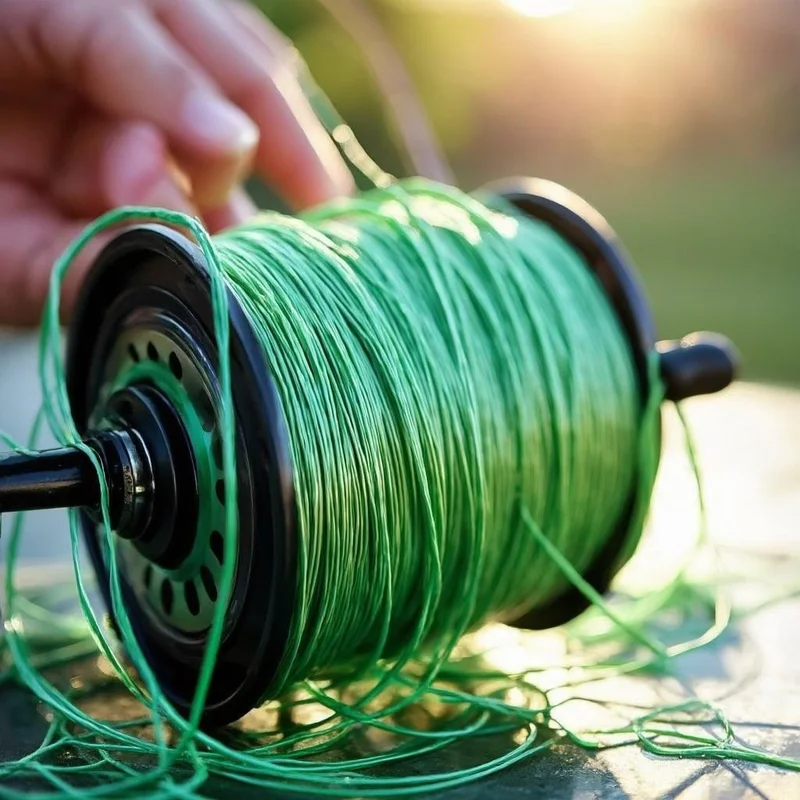
You know the scene. You open your bail to cast and the line springs off the spool in tight coils , like a slinky falling down stairs.
That's line memory, and it's the single most common complaint at the boat ramp.
Line memory happens when monofilament or fluorocarbon retains the curved shape of the spool it's been wrapped around.
The polymers literally "set" into that bent position over time, especially when stored in a hot garage or car trunk.
According to research from the polymer science community, nylon monofilament undergoes what's called stress relaxation , the molecular chains reorganize to match whatever shape they're held under tension.
That's why the line buried deepest on your spool (tightest bend radius, longest time under tension) has the worst memory.
Master Fishing Mag's detailed breakdown of line memory physics notes that three factors control severity: tighter bend radius, more heat, and more time , and all three compound each other.
Memory doesn't just look ugly. It cuts casting distance by 15-30% because the coils drag against your rod guides. It causes wind knots because loose loops tangle as they leave the spool.
And it kills lure presentation because the line won't track straight through the water.
Severe memory costs casting distance on a 7-foot medium-light spinning rod , same lure, same conditions , simply because year-old mono will not come off the spool clean the way fresh line does.
The fix depends on your line type:
How to Fix Line Memory by Material
- Monofilament: Remove the spool, run very warm (not boiling) tap water over it for 1-2 minutes while rotating. The heat relaxes the nylon polymers. Let it cool under light tension.
- Fluorocarbon: Warm water barely touches fluoro. Instead, tie the end to a fence post or tree, walk out 50-75 feet, and stretch firmly in 3-foot sections. Steady mechanical tension is the only thing that works.
- Braid: Has effectively zero memory , woven fibers don't set like extruded plastic. This is why so many experienced anglers run braid main line with a short fluoro leader. No memory, no problem.
- Prevention: Store rods in a cool, dark place. Never leave them in a hot vehicle. Use larger-arbor reels when possible , the shallower bend radius significantly reduces memory formation.
Problem #2: Line Twist , The Silent Spool Killer
Line twist is different from memory, and confusing the two leads to applying the wrong fix. Memory produces large, even coils that match the spool curvature.
Twist produces tight corkscrews and pigtails that appear mid-line, especially in slack sections. Stretching won't fix twist, and untwisting won't fix memory.
You have to diagnose which one you're dealing with or you'll waste an hour achieving nothing.
Twist builds up from three main sources. First, and most damaging: reeling against a slipping drag.
When a fish pulls line against your drag and you keep turning the handle, every single crank adds 4-6 full twists to your line.
One hard fight with bad technique can destroy a spool in under two minutes.
KastKing's technical breakdown confirms this: "Every turn of the reel handle puts 4 to 6 twists in your line depending on your reel's gear ratio."
Second: using inline spinners, spoons, or any rotating lure without a quality swivel. The lure spins on retrieve, and that rotation transfers directly into your line.
Trolling a spoon without a swivel is the fast track to this problem. Two hours of that and the line looks like a phone cord.
Third: closing the bail by turning the reel handle instead of doing it manually. This leaves a loose loop that doesn't seat properly against the line roller, creating micro-twists that accumulate over hundreds of casts.
How to Fix Line Twist
- On the water: Remove all terminal tackle. Let 60-80 yards of bare line trail behind the boat at idle speed for 2-3 minutes. Water resistance naturally untwists the line. Reel back under finger tension.
- From shore: Walk the line out across an open field, tie to a swivel, and let the swivel freely rotate as you reel back under tension.
- Prevention: Always close the bail by hand. Never crank while the drag is singing. Use ball-bearing swivels with any rotating lure. When spooling fresh line, match the supply spool direction to your bail rotation.
Problem #3: Wind Knots , The Mid-Cast Explosion
Wind knots are what happens when line memory or twist meets a bad cast.
They're named for what triggers them , casting directly into a headwind , but the root cause is almost always a pre-existing condition on the spool. The wind just exposes it.
According to Salt Strong's detailed analysis, wind knots almost never happen when you think they do.
There's a specific moment that sets them up , a loose loop on the spool that goes unnoticed , and the actual tangle only shows up on the next cast when that loop gets pulled into the chaos.
Here's what's happening mechanically: loose line on the spool peels off faster than the tighter coils around it.
When that loose section hits the first guide, it overtakes the preceding line and ties itself into a knot.
The "wind" part comes from the fact that a headwind slows your lure mid-flight, creating slack in the line behind it while line is still screaming off the spool.
Two flows, different speeds, same space , knot.
The fix isn't a shorter cast. The fix is eliminating the loose line on your spool before you ever make that cast. After every retrieve, glance at your spool.
If you see any loop sticking up, pull it tight manually before your next cast. Keep the spool filled to the proper level , leaving 1/8 inch of lip showing.
And for braid users: braid is notorious for wind knots because it has zero stretch to absorb those speed differentials. A slightly tighter spool fill with braid actually helps.
Problem #4: Abrasion , The Invisible Nick That Costs Trophy Fish
Fishing around rocks, docks, bridge pilings, oyster beds, or timber is a fact of life for most anglers. Every time your line touches structure under tension, it's getting micro-abraded.
One small nick can reduce breaking strength by 50% or more , and you won't see it until the line fails.
Fishing Gear Insider's testing confirms: "A damaged section may still hold under light pressure but fail instantly during a powerful hook set or surge from a large fish."
Run the last 3-4 feet of line between your thumb and forefinger after every fish, every snag, and every cast that ticks structure.
If it feels anything but perfectly smooth, cut and retie. Around rocky smallmouth structure that habit costs a few minutes of fishing time and nothing else.
That might sound excessive, but it removes most mystery breakoffs from a season.
Without that habit, a couple of mystery breakoffs per trip are normal. They stop being mysterious once the last few feet get checked.
Fluorocarbon offers substantially better abrasion resistance than monofilament , substantially better in head-to-head rock-scrape tests Tackle Warehouse's comparison data. But it's not invincible.
Braid has the worst abrasion resistance of the three and will part instantly on a sharp rock edge. If you fish braid around structure, a fluorocarbon leader of at least 4 feet is non-negotiable.
Problem #5: Old Degraded Line , When "It Looks Fine" Is a Lie
A spool of monofilament run for two seasons still looks fine. It feels fine, too.
Then knot strength seems to drop, and fish come off hook sets that felt solid. The truth: UV radiation, heat cycling, and moisture degrade nylon polymers continuously.
The line can lose 20-30% of its rated breaking strength while looking completely normal to the naked eye.
Monofilament degrades fastest , Fishing Gear Insider recommends replacement every 3-4 months for frequent anglers and every 6-12 months for weekend warriors. Fluorocarbon handles UV better but still degrades, especially in heat.
Braided line lasts the longest , 3-5 seasons with proper care , though the first 20-30 feet near the terminal end should be trimmed every few trips as it takes the most abuse from guides and structure.
Here's a workable replacement schedule:
| Line Type | Weekend Angler | Weekly Angler | Tournament/Saltwater |
|---|---|---|---|
| Monofilament | Every 6-8 months | Every 3-4 months | Every 1-2 months |
| Fluorocarbon | Every 8-12 months | Every 4-6 months | Every 2-3 months |
| Braided Line | Every 18-24 months | Every 8-12 months | Every 4-6 months |
A simple field test: run 3-4 feet of line between your fingernails. If it feels rough, gritty, or shows any flattening , it's time.
If the color has faded noticeably from when it was new, the UV damage has already set in. Replace it.
A $10-15 spool of fresh line costs less than one lost crankbait, and far less than the heartbreak of losing a fish you'll remember for years.
Problem #6: Poor Knots , The Weakest Link You Control
A poorly tied Improved Clinch knot on fluorocarbon can retain as little as 60-65% of the line's rated strength.
A properly tied Palomar knot on the same line? 90-95%. On 8lb test, that's the difference between the knot breaking at 5.2lb versus 7.6lb.
That's a 2.4lb window where a good knot lands the fish and a bad one hands it a free lure.
The three most common knot mistakes: not wetting the line before cinching (fluorocarbon generates heat under friction that internally burns and weakens the line), using too few or too many wraps (5-7 for most knots on light line, 4-5 on heavier), and pulling the tag end instead of the standing line to tighten.
The standing line does the work. The tag end is just the tail. Tug the tag end hard and you'll kink the knot, creating a stress point that fails under load.
For 90% of freshwater fishing, two knots cover almost everything: the Palomar for terminal connections (lure/hook to line) and the Uni-to-Uni or FG knot for braid-to-leader connections.
The Palomar is dead simple, works on every line type, and delivers consistently excellent knot strength.
If you only master one knot beyond the basic clinch, make it the Palomar.
Problem #7: Wrong Spool Fill , Over vs. Under
Overfilling your spool is the most common beginner mistake. The thinking is logical: more line equals more capacity.
But fill the spool right up to the lip and the top layers have nothing to hold them in place.
On the cast, the outermost coils peel off in chunks instead of smoothly, creating loops that tangle immediately.
Bank anglers spend more time picking out wind knots than actually fishing, all because their spools were overfilled.
Underfilling causes the opposite problem but with the same result: reduced performance. A half-empty spool has a smaller effective diameter, which means the line has to travel farther around the spool lip per rotation.
More friction, shorter casts, and slower retrieval. The line near the arbor on an underfilled spool is also sitting at a much tighter bend radius, which accelerates memory formation.
The sweet spot: leave approximately 1/8 inch (about 3mm) of spool lip exposed. This provides enough rim to keep the coils contained while maximizing the effective spool diameter for casting distance.
On most size 2500-3000 spinning reels, this means stopping the fill when the line is about 1.5mm below the beveled lip edge.
Get this right and you'll eliminate roughly 40% of the tangling issues that plague casual anglers.
The 5-Minute Pre-Trip Line Check
Everything above boils down to a routine that takes five minutes before every trip:
Your 5-Minute Pre-Trip Line Inspection
- Minute 1 , Memory check: Pull 20 feet of line off the spool and let it hang. If it holds tight coils, soak mono spools in warm water or stretch fluoro before you launch.
- Minute 2 , Abrasion check: Strip the last 10 feet and run it between your fingers. Any roughness? Cut back until the line feels perfectly smooth, then retie.
- Minute 3 , Spool fill check: Is there 1/8 inch of lip showing? If overfilled, strip some line off. If underfilled, top up or respool.
- Minute 4 , Knot check: Give your terminal knot a firm pull test. If it slips even a millimeter, cut and retie. Wet it this time.
- Minute 5 , Age check: When did you last respool? If you can't remember, it's been too long. Fresh line costs less than lost fish.
Two Lines That Cut Most of These Problems
Line quality is the difference between managing these problems and chasing them. Cheap gas-station monofilament costs you more in lost fish and frustration than the few dollars you save.
Here are two lines that earn a permanent spot on a spinning rod:
Berkley Trilene XL Smooth Casting , 8lb
For anyone frustrated with memory and tangling, this is the mono to start with. Berkley formulated Trilene XL specifically for low memory, and it shows , it comes off the spool noticeably limper than budget mono.
The 330-yard spool runs about $8-10, which is a bargain considering how much it cuts wind knots compared with stiff budget mono.
It is forgiving enough for finesse spinning setups and for rods handed to beginners, who spend more time fishing and less time untangling.
The clear version disappears in most water conditions, and the knot strength is consistent across the entire spool.
Check Price on AmazonKastKing SuperPower Braid , 20lb
For anglers ready to eliminate memory permanently, this is the easy recommendation. KastKing SuperPower Braid has effectively zero memory , it comes off the spool like thread, not wire.
At roughly $15 for a 300-yard spool, it's priced accessibly for trying braid without committing to premium price tags.
The 20lb test has a diameter equivalent to 6lb monofilament, so you get triple the strength in the same spool space.
Pair it with a 4-6 foot fluorocarbon leader and you eliminate memory entirely while keeping invisibility at the business end.
A spool of this lasts seasons on a primary spinning rod, not months.
The one caveat: braid's abrasion resistance is poor against sharp rocks, so that fluoro leader isn't optional , it's mandatory.
Check Price on AmazonFAQ
What's the #1 cause of fishing line breaking unexpectedly?
By far, the most common cause is undetected abrasion damage. Anglers fish around rocks, docks, and timber for hours without checking their line.
A tiny nick invisible to the naked eye can reduce breaking strength by over 50%. Run your fingers along the last several feet of line after every fish and every snag.
If it's not perfectly smooth, cut and retie. This single habit will eliminate more "mystery breakoffs" than any gear upgrade ever could.
Should I use mono, fluoro, or braid to avoid the most problems?
For overall lowest problem rate, braid main line with a fluorocarbon leader is the winning combination.
Braid has zero memory (eliminates problem #1), doesn't twist permanently (minimizes problem #2), and lasts 3-5 seasons (solves problem #5). The fluoro leader handles abrasion (problem #4) and invisibility.
The trade-off is that you have to learn one connection knot (Uni-to-Uni or FG), and braid requires slightly different drag management.
But once you dial it in, you'll spend dramatically less time fighting your line and more time fighting fish.
For more detail on the mono vs braid decision, see our braided line vs mono guide.
How can I tell if my line is too old to use?
Three tests: First, the fingernail test , run 3-4 feet between your thumb and forefinger. Rough or gritty texture means the polymer surface has degraded.
Second, the color test , compare it to fresh line from the same brand. Significant fading indicates UV damage has penetrated the material.
Third, the stretch test , tie the line to something solid, pull until it breaks, and compare the force to the rated strength.
If it breaks at noticeably less than the label rating, the internal polymer chains have weakened. When in doubt, replace it. A $12 spool of fresh line is cheaper than losing one good fish.
Does line conditioner actually help with memory?
Yes, but it's a temporary treatment, not a permanent fix.
Products like Blakemore Real Magic and KVD Line & Lure Conditioner add a polymer-bonding lubricant that reduces friction and softens the outer layer of mono and fluoro.
They make the line more supple for a few hours and help prevent memory from setting as quickly. Think of it like hair conditioner , it helps manageability but doesn't repair damage.
Apply before each trip, let it dry for 30 seconds, and you'll notice fewer tangles and longer casts.
It won't fix line that's already severely coiled, though , for that, you need the warm water soak or stretch method.
Sources & Industry References
- Fishing Gear Insider , Comprehensive breakdown of 13 common line mistakes with degradation timelines and replacement schedules
- Master Fishing Mag , Detailed analysis of fishing line memory physics, polymer chain behavior, and material-specific fixes
- Sports Illustrated Fishing , Pro angler techniques for preventing and fixing line twist on spinning reels
- Salt Strong , In-depth wind knot analysis showing why tangles happen when they do and how to read spool conditions
- KastKing , Technical explanation of line twist mechanics, including the 4-6 twists per handle turn statistic
Found This Guide Helpful?
Check out LineCalc Pro , our free fishing line calculator that recommends the perfect line for your exact setup. No guessing, no wasted money.
Try LineCalc Pro →